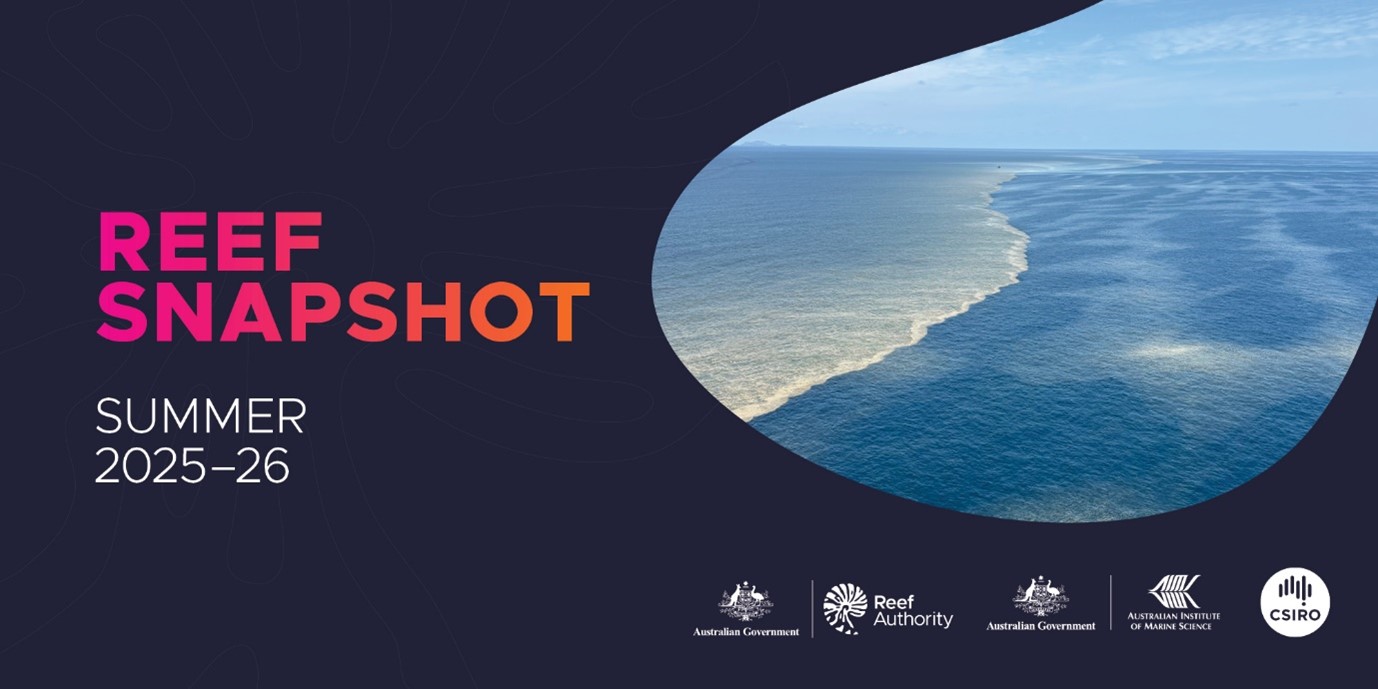
The Reef snapshot: summer 2025-26 provides a summary of conditions on the Great Barrier Reef throughout summer, and how these conditions impact coral and Reef health and the actions being taken to help coral health.
The snapshot is a joint initiative of the Australian Government’s lead management and science agencies for the Great Barrier Reef, the Great Barrier Reef Marine Park Authority, the Australian Institute of Marine Science and CSIRO.
The snapshot is based on the latest available science and information at the time of writing.
It sets the scene for more comprehensive reports later in the year, such as the mid-year Long-term Monitoring Program reports by the Australian Institute of Marine Science and Marine Monitoring Program reports by the Great Barrier Reef Marine Park Authority.
The snapshot provides a point-in-time summary of Reef health monitoring conducted each year.
Click here to download the Reef snapshot: summer 2025–26.
- Key findings:
- The snapshot provides a summary of conditions on the Great Barrier Reef from December 2025 to March 2026, how those conditions impacted coral, and actions in place to help coral reefs.
- The snapshot focuses on coral and does not present information on the health of other habitats or species.
- The Great Barrier Reef was impacted by cumulative pressures during the 2025–26 summer, including prolonged heat exposure, two tropical cyclones and a tropical low, flooding in the catchment, and outbreaks of the coral-eating crown-of-thorns starfish.
- Prolonged heat exposure resulted in a regional coral bleaching event in the Northern region and localised low levels of coral bleaching in the Far Northern, Central and Southern regions of the Reef.
The ongoing fourth crown-of-thorns starfish outbreak continues to impact parts of the Southern region with a fifth outbreak emerging in the Northern region. - While high rainfall and increased cloud cover from monsoonal systems and cyclones reduced the accumulation of thermal stress in some areas, the associated flood plumes reduced the salinity of the surrounding seawater and likely increased levels of nutrients, sediments and pesticides.
- Climate change remains the greatest threat to the Reef, and coral reefs worldwide.
The full extent of cumulative impacts from this summer and previous years is still being assessed.
In-water surveys and observations will continue during the year across various partners through the Marine Monitoring Program, Australian Institute of Marine Science Long-Term Monitoring Program, Reef Joint Field Management Program, Crown-of-thorns Starfish Control Program, tourism operators, researchers and Traditional Owners.