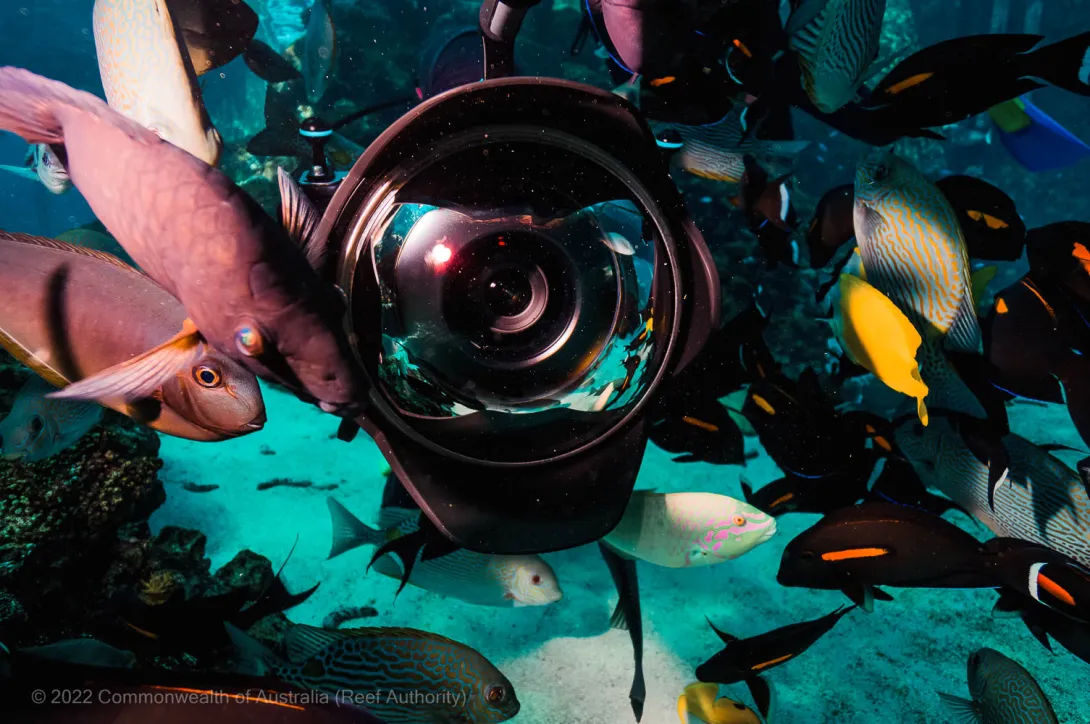
The Great Barrier Reef Marine Park is one of the world's natural wonders and has been featured in numerous documentaries, films and photographic works.
Under the Great Barrier Reef Marine Park Zoning Plan 2003, photography, filming and/or sound recording on or under the water is allowed without a permit in most areas of the Marine Park if it is done in a way that has, or is likely to have, negligible impact on the Marine Park.
The Great Barrier Reef Marine Park Authority (the Authority) has developed guidelines to explain what types of recording equipment and methods are considered to cause negligible impacts on the values of the Marine Park. These are referred to as ‘low impact recording’.
Principles of low impact recording
- Equipment or props are free-standing or hand-held. No equipment or props are fixed in place or left unattended, even temporarily.
- Free-standing equipment (such as tripods) or props do not come into contact with coral.
- The recording activity does not restrict public access or public use of a location.
- Non-endemic plants, animals or biological materials are not used.
- Approach distances for cetaceans (dolphins and whales) comply with Part 9 of the Regulations.
- Plants or animals are not taken, touched, handled, manipulated, fed, attracted with food or otherwise disturbed.
- When recording nesting marine turtles and hatchlings - the recording does not involve the use of a light, approaching turtles from the front (direct line-of-sight vision of animal) or any physical interaction with the turtles (for example, moving hatchlings to improve the recording).
- Non-living materials (sand, rocks, etc.) are not intentionally moved or manipulated beyond what is likely to be naturally restored within 24 hours.
- Pyrotechnic effects, such as simulated explosions, are not used.
- Unusual lighting is not used, for example strobe lighting, very high intensity lights or extended night lighting at a single location.
- Autonomous vehicles (for example robots) are not used (see Definitions section of photography, filming and sound recording guidelines).
- Managed vessel or aircraft are not used (see Definitions section of photography, filming and sound recording guidelines).
- Support vessels, equipment or platforms have legal authority to operate in the Marine Park for the intended purpose (for example, chartered vessels hold a valid permit to conduct a non-tourist charter operation that includes access to the proposed locations).
- Where using remotely operated vehicles (such as drones):
- Aerial units weigh less than five (5) kilograms (including equipment).
- Surface or submarine units weigh less than 25 kilograms (including equipment).
- Aerial units do not operate within aircraft exclusion areas (see Location-specific assessment guidelines).
- Units do not approach closer than:
- 20 metre radius from marine turtles;
- 30 metre radius from crocodiles;
- 30 metre radius from dugongs;
- 75 metre radius from seabirds.
- Requirements and guidelines under other legislation are adhered to, including:
- For aerial units - Civil Aviation Safety Authority (CASA)
A recording that cannot comply with all of the above principles is likely to require permission for this activity to take place in the Marine Park.
For further information and to determine if a permit is required, you should refer to our photography, filming and sound recording guidelines. These filming guidelines apply to Commonwealth waters of the Great Barrier Reef Marine Park. Activities within the Great Barrier Reef Coast Marine Park (Queensland), e.g. intertidal areas, beaches and rivers may require a state-only permission.
Some activities and operations occurring in the Great Barrier Reef Marine Park and the Great Barrier Reef (Coast) Marine Park, especially those of a commercial nature, require a permit.
Permits are issued by the Great Barrier Reef Marine Park Authority and the Queensland Department of Environment and Science through a joint permission system.
The Permission System Policy outlines the approach to managing the permission system within the Marine Parks.
If you have established that your proposed activities will require a permit, your application can be submitted using the Authority’s Permits Online System. Please review the recording guidelines and information checklist for filming applications when developing your application. Applications are assessed in accordance with the Authority’s Assessment and Decision guidelines. All filming applications are assessed in accordance with the tailored assessment approach. A decision notice will be given within 50 business days of the application being accepted as properly made.
A permit application assessment fee may apply. Refer to the Application Guidelines for full details, and a list of fees for the current calendar year is also available. Filming permit application assessment fees are listed as ‘activity not listed above’.
Most permits have conditions requiring the permission holder to provide indemnities and take out insurance, currently permit holders must obtain $20 million in public liability insurance.
Please be aware there are also guidelines for being a responsible reef user to ensure marine life is not adversely affected.
The Queensland government has specific requirements for commercial filming and photography in areas managed by the Department of Environment, Tourism, Science and Innovation (DETSI).
Where the activity is proposed to be conducted partly or wholly in Queensland only jurisdiction (for example, on island national parks, cays and within the intertidal zones (beaches) a permission/authority may be required.
Intertidal areas / beaches
Generally, the State marine park intertidal areas/beaches are managed complementarily with the Commonwealth filming guidelines. Impacts on other users of the marine park and the values of the adjoining national parks are also considered.
Proponents are recommended to contact DETSI via email to arrange a pre-lodgment meeting and to discuss any possible permit requirements. Please contact at permitsGBR@detsi.qld.gov.au.
Island National Parks (Protected Areas)
Please refer to the following information for commercial filming and photography in national parks, conservation parks, recreation areas and state forests.
Proponents are recommended to contact DETSI to arrange a pre-lodgment meeting and to discuss any possible permit requirements. Please contact at permitsGBR@detsi.qld.gov.au.
Queensland’s Operational Policy on commercial filming and photography provides more information.
If permission is required for the use of a drone, the application assessment considers the same matters as for general recording, and also:
- The purpose of the filming – use of a drone that poses a greater risk (of a larger size or in a sensitive area) will generally only be considered if the filming will significantly enhance scientific understanding or public appreciation of the Marine Park or a specific value.
- Any requests for landing(s).
- The operator’s qualifications and experience, including their knowledge of the proposed location.
- The risks posed by the device should it contact sensitive habitats or species or breach exclusion limits (e.g. seabird or shorebird nesting areas).
- The risks posed by the device should it be lost (for example, whether the device may leach toxic chemicals or break into pieces).
- The disturbance posed by noise relative to the proposed approach distances and species of interest.
Information is available on the requirements for the use of unmanned aircraft for filming and research purposes.
Information is available on the requirements for the use of unmanned aircraft for filming and research purposes.
If an application relates to recording involving cetaceans, the film crew and associated vessels must abide by Part 9 of the Regulations which limits interactions with cetaceans, such as approach distances.
Under Section 188(1)(b), a person may be given an exemption to the approach limits as part of a permission for recording. Cetacean exemptions are assessed on a case-by-case basis in accordance with legislation.
Where the filming plan does not comply with low-impact recording principles and requires a permit, including a request for an exemption, the Authority must consider whether the conduct will adversely affect a cetacean, the conservation status of a species of cetacean or a population of a species of cetacean (Section 105(2) of the Regulations).
Refer to the Assessment guidelines for more information.
Please note that permits for filming in Preservation Zones and some Scientific Research Zones are unlikely to be approved.
Filming in Planning Areas must comply with all relevant provisions of the statutory plans, including limits on vessel and group sizes. See the Location-specific assessment guidelines and Plans of Management for more information.
Activities in Special Management Areas may require a permit, depending on the area and the timing of filming.
Restricted Access Special Management Areas may have special rules or policies related to recording. See the Location-specific assessment guidelines and section 47 of the Regulations for more information.
The Authority cannot grant permission for recording in Maritime Cultural Heritage Protection Special Management Areas unless it will improve public education about, or understanding of, cultural heritage (Section 53(2)). Refer to the Maritime cultural heritage SMA guidelines for more detail.
A wide range of video and audio recordings are allowed without permission when operating under research accreditation. Refer to the Authority’s Guidelines on managing scientific research.
In some cases, it may be necessary to differentiate between recording for legitimate research purposes and recording for the purposes of education, information or entertainment.
Examples
- If a researcher wanted to record images along a transect in order to later review the footage to count fish or determine other scientifically relevant information, this would be classified as recording for research purposes.
- If a commercial filmmaker wants to record a researcher tagging marine turtles as part of a weekly television series, this would not be recording for the purpose of research and would not generally be allowed under the researcher’s permit. Rather, the filmmaker would need their own permit to conduct filming (unless the recording complies with the principles for low impact recording).
- If a freelance photographer wants to photograph a research project in order to sell the photographs, this would not generally be allowed under the researcher’s permit. Rather, the photographer would need their own permit to conduct photography (unless the recording complies with the principles for low impact recording).
Filming of a research project must not cause additional research activities than would not be conducted without filming. For example, additional animals should not be collected for the purpose of capturing a better shot. If additional activities are required, this should be included in the filming permit application and will be considered on a case-by-case basis.
Further information
If you have any questions please contact our team:
Email: assessments@gbrmpa.gov.au
Phone Permits: 07 4750 0700 - option 3
Media hotline: 07 4750 0846