
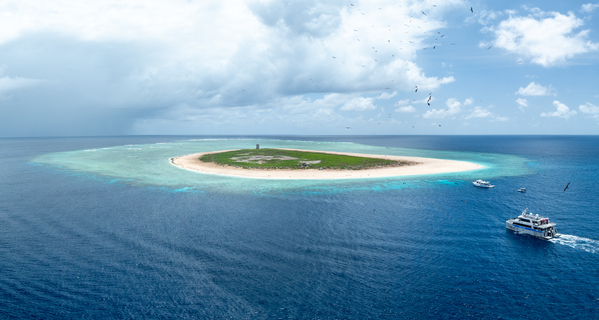
Thousands of turtles have been counted, rescued, tagged or relocated in the latest scientific voyage to Raine Island.
A collaboration between Queensland Parks and Wildlife Service and the Great Barrier Reef Marine Park Authority has seen thousands of turtles counted, rescued, tagged, relocated and hatched on Raine Island.
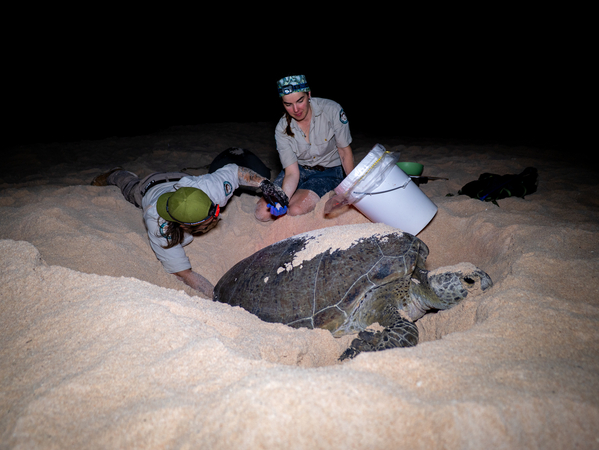
The Raine Island Recovery Project - completed in December 2025 - documented almost 20,000 turtles gathering in the ocean and almost 4,000 turtles coming onto the island at night to lay eggs.
Raine Island is the world’s largest green turtle rookery and is the source of almost 90 per cent of the northern Great Barrier Reef green turtle population.
Funding for the project first began back in 2015, starting with expeditions to re-shape the island and reduce nesting risks.
Federal Minister for the Environment and Water Murray Watt said green turtles faced enormous pressures from climate change and projects like this were critical in giving them a fighting chance.
- “Warming temperatures mean that without intervention species like the green turtle, one of 110 priority species under the Australian Government’s Threatened Species Action Plan, are at heightened risk of extinction,” Minister Watt said.
“By working closely with the Queensland Government, Traditional Owners, scientists and industry, we’re tackling these challenges head-on to protect this iconic species around the Great Barrier Reef for generations to come.”
Queensland Minister for the Environment Andrew Powell said while small, Raine Island was vital for the survival of many species.
- “I’ve been so proud to step back into this program that started back when I was the Environment Minister in 2015,” Minister Powell said.
“Our work here has really paid off, as we’ve seen the species grow in number by an estimated 640,000 over the years.”
Chair of Mer Gedkem Le RNTBC Falen Passi, said they had deployed three satellite tags this season and were excited to see where they went after nesting.
- “As previous satellite tags have shown that green turtles migrate back to feeding grounds in the northern Great Barrier Reef and the Torres Strait,” Mr Passi said.
Chair of Wuthathi Aboriginal Corporation Keron Murray said another great achievement was that an additional 50 clutches have been relocated from Raine Island to the shade structure on Sir Charles Hardy (Wuthathi National Park), as part of the Project Egg Relocation Program.
- “That makes 100 clutches to have been relocated to the shade structure, and we’re using temperature logging devices to see if shade cloth can cool incubation temperatures to help produce more male hatchlings,” Mr Murray said.
The December 2025 visits - part of the Raine Island Recovery Project - were a collaboration between the Queensland Government, the Australian Government and the Wuthathi People and Meriam Nation (Ugar, Mer, Erub).
The $3.5 million Raine Island Recovery Project is funded through the Australian Government’s Saving Native Species program.
For more information, visit https://parks.qld.gov.au/raineisland
ENDS
Contact:
Great Barrier Reef Marine Park Authority | (07) 4750 0846 | media@gbrmpa.gov.au
Department of the Environment, Tourism, Science and Innovation
(07) 3339 5831 | media@des.qld.gov.au