
Aboriginal and Torres Strait Islander people should be aware that this story contains images and names of deceased persons.
On a small but spectacular coral cay, just off the far North Queensland coast, a simple gravesite serves as a solemn reminder. The Great Barrier Reef is one of the most complex ecosystems on earth and a tourist destination unlike any other. But for some of the region’s earliest maritime pioneers it could be a harsh and unforgiving frontier, where the lines between paradise and peril often blurred. Now, beneath shifting sands, their stories – and the Reef’s hidden heritage - are slowly coming to light.
When people picture the work of marine park managers, they often imagine scientists tagging turtles or counting corals. Few would picture them kneeling in the dunes, gently brushing away grains of sand from a 140-year-old grave.
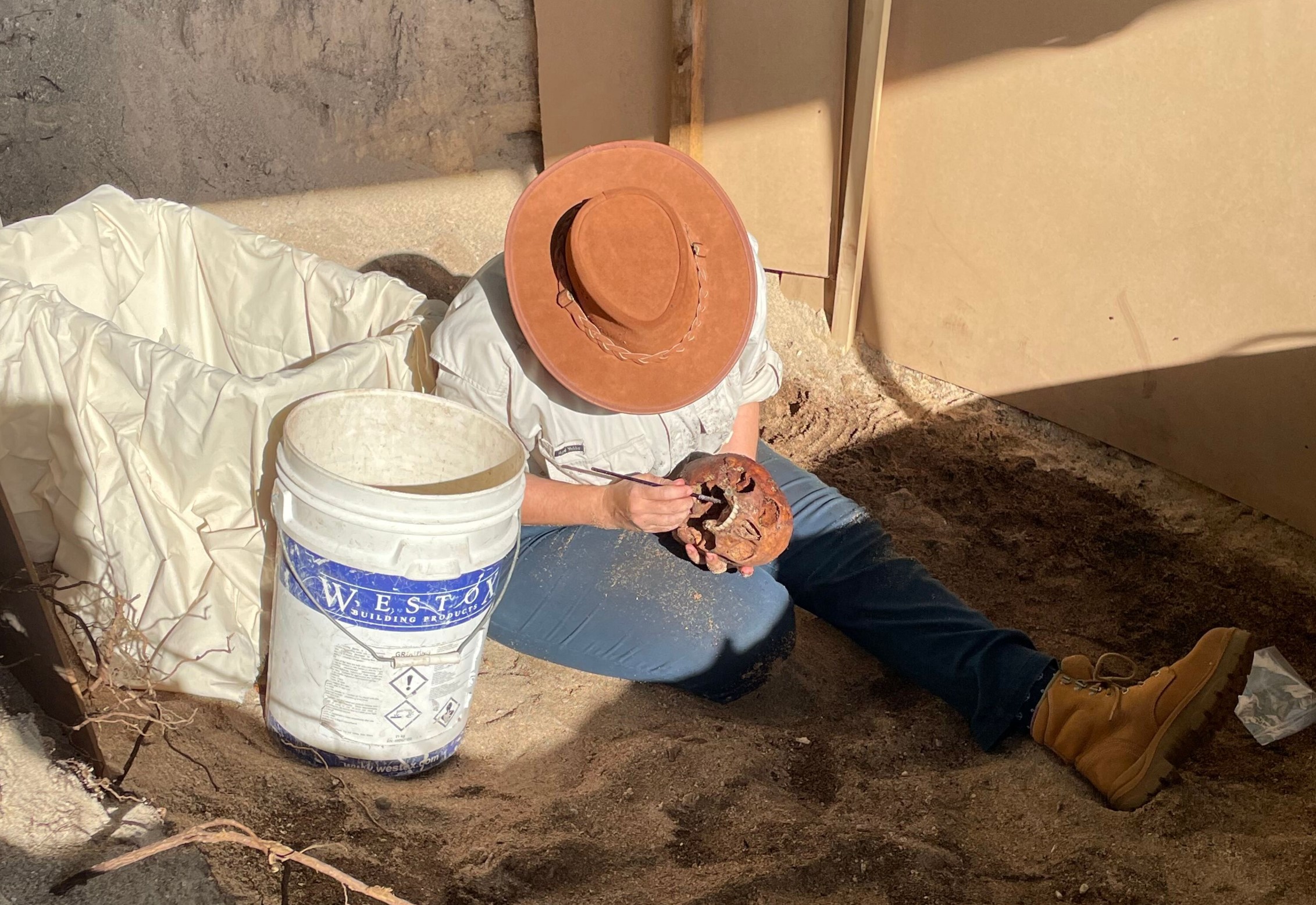
Protecting the Great Barrier Reef is not only about safeguarding marine life. It also means caring for the human stories embedded in its islands and waters: from lighthouses and shipwrecks to lives shaped by resilience and loss.
Nowhere is that connection more vividly illustrated than on Low Island, part of the Low Isles group, located 15 km off Port Douglas. And it was here, where a unique project was born, after encroaching waves and rising tides threatened to wash away one of the island’s most incredible stories.
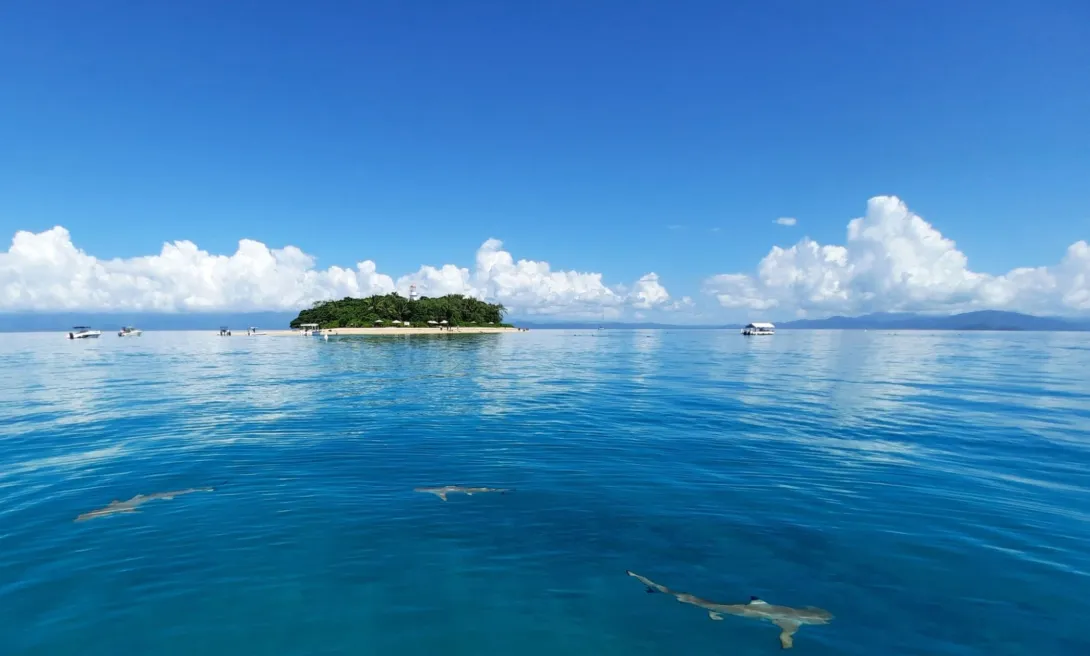
Low Island is the final resting place of Jane Ann Owen, wife of the island’s first lighthouse superintendent, Daniel Owen.
Coral cays are shaped by the winds and the currents, meaning they are constantly shifting and by 2022, more than a century after she was laid to rest on the island’s western shore, rising tides were lapping at Jane’s grave.
A collective decision was made to exhume her remains and move her grace to a site more protected from the elements. This was undertaken by the Great Barrier Reef Marine Park Authority and the Queensland Department of the Environment, Tourism, Science, and Innovation (DETSI), supported by Traditional Custodians, university archaeologists, island caretakers and community volunteers.
Over three years, the team pieced together a unique and moving story, one that reminds us why protecting the Reef means protecting its past as well as its future.
An island of light and loss
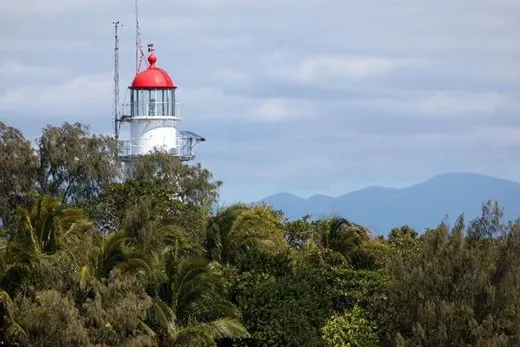
In the late 19th century, lightstations were frontier posts. Families sent to tend them lived in profound isolation, dependent on rare supply boats and vulnerable to cyclones and sickness. For Jane, who journeyed across the country with her husband Daniel and their young daughter Susie to take up the post in 1878, life on Low Island meant hardship in an unfamiliar climate and, ultimately, tragedy.
Jane’s death left a young family behind on a remote island seemingly, at the edge of the world. When she passed in 1880, Jane was buried close to where she lived, her grave originally marked simply by a cross nailed to a tree and left to the elements.
A race against the tide
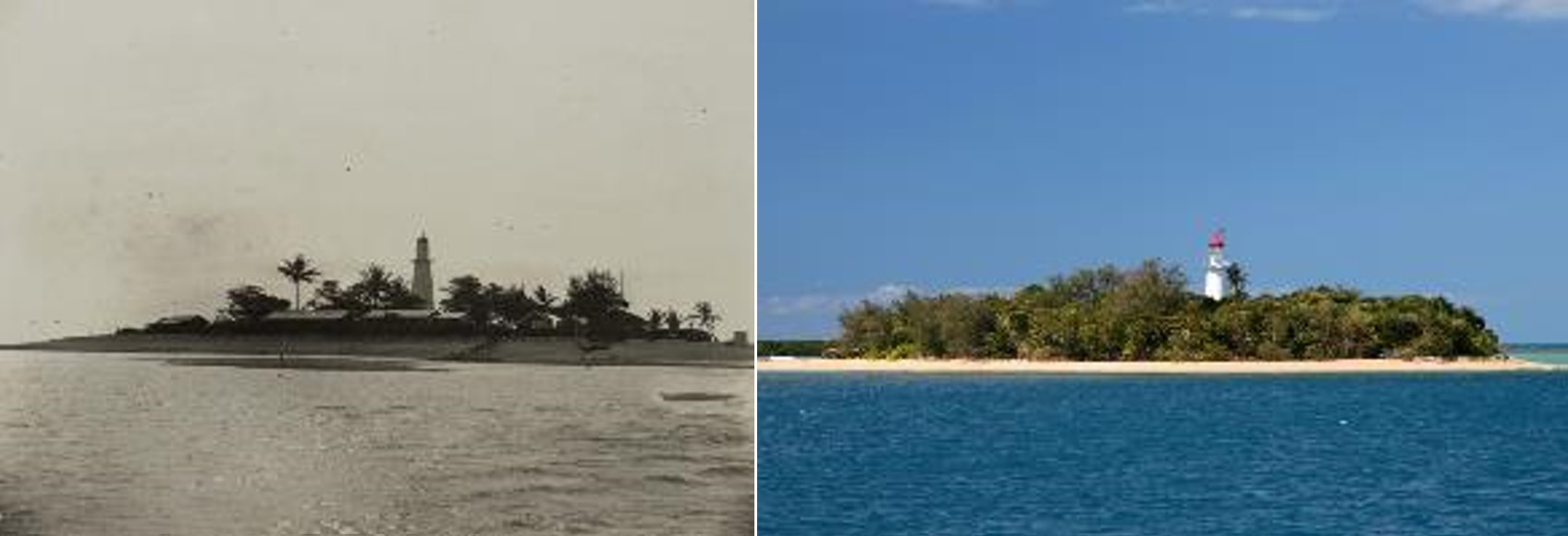
Decades of shifting sand and seasonal storms slowly narrowed the distance between Jane’s resting place and the sea. By the early 2020s, erosion had stripped away the protective dune, leaving the grave exposed.
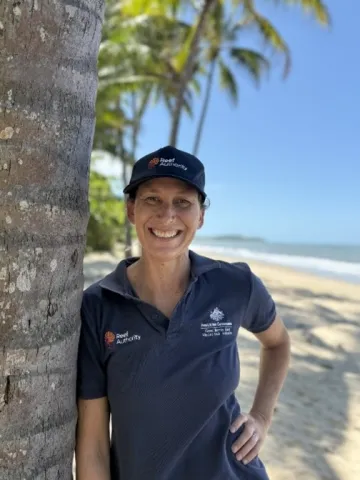
“By the time we intervened, erosion had cut almost to the headstone,” Reef Authority Commonwealth Islands Manager Alicia Moisel said. “It was a race against time.”
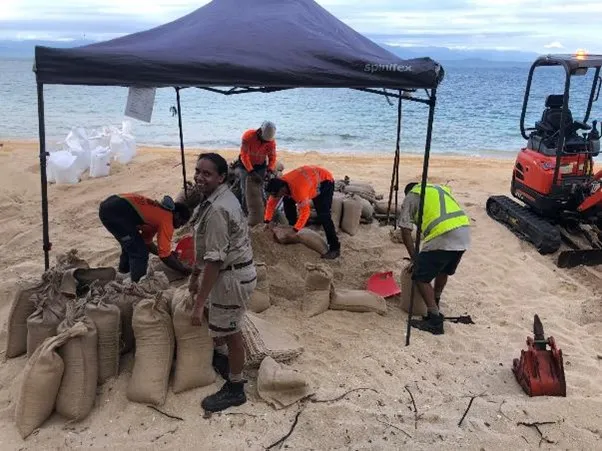
Temporary sandbag walls constructed with the support of QPWS and Indigenous rangers offered a brief reprieve, but Alicia and those involved faced a stark choice; allow the grave to be lost to the sea or relocate it further inland to safer ground.
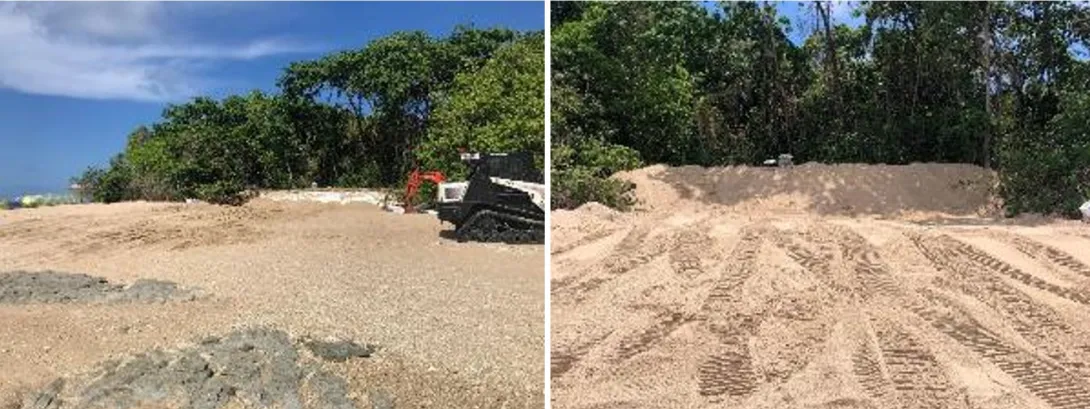
That decision marked the beginning of the Low Isles Gravesite Relocation Project, an undertaking that combined archaeology, heritage management, cultural advice… and a lot of sweat and sand.
The first excavation began in November 2023. At that point, no one knew for certain whether the grave contained human remains or was only a memorial. The grave markers were carefully lifted and moved inland to a location still accessible to visitors but less threatened by erosion.
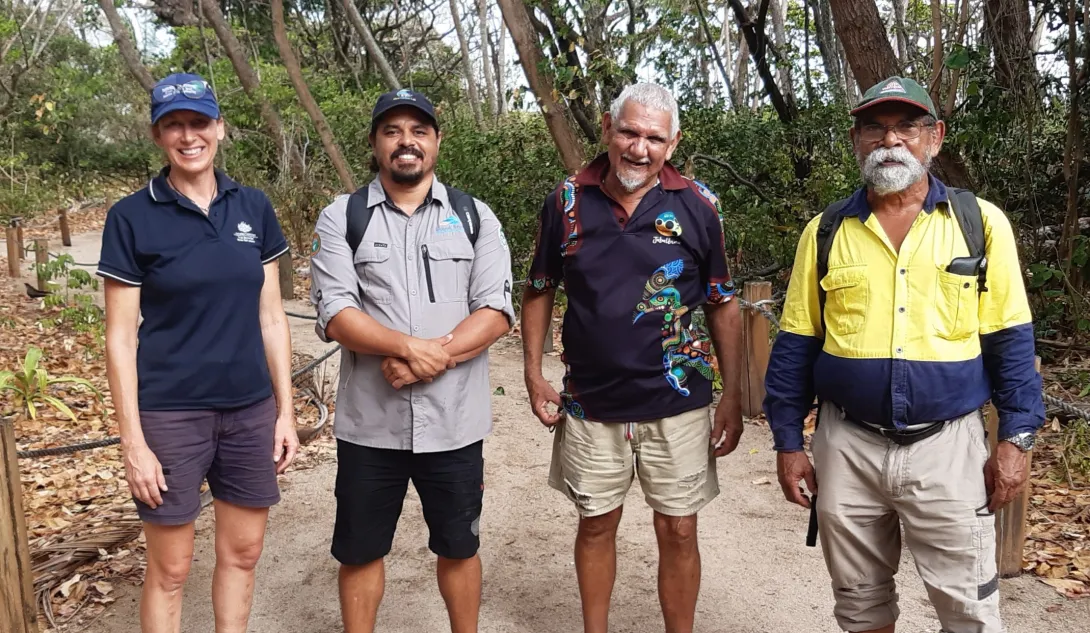
Soon after the dig began, watched closely by Eastern Kuku Yalanji and Yirrganydji cultural advisors, who also provided guidance and field assistance throughout the project.
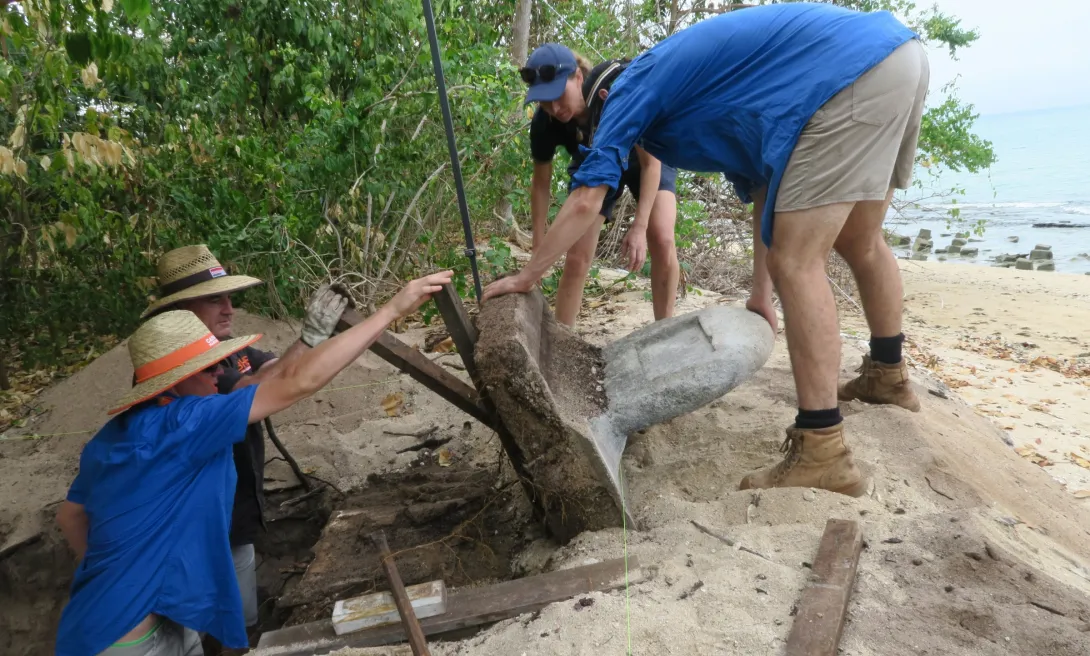
First the dig team uncovered a layer of asbestos sheeting, a material not used in Australia until decades after Jane’s death, confirming the original cross had been replaced later by the stone grave markers and headstone that we see today. Next came a single small bone fragment. Laboratory analysis confirmed it belonged to a woman in her 40s and evidently, Jane Owen, although this was yet to be officially confirmed as the dig was temporarily halted to address some safety issues associated the discovery of the asbestos containing materials.
A woman revealed
The answer came in September 2024, when a second excavation team returned. Led by DETSI Principal Heritage Officer and archaeologist Celeste Jordan with University of Southern Queensland Senior Archaeologist Dr Bryce Barker, the team stabilised and further excavated the site over several hot, sandy days.
The dig soon revealed the remarkably well-preserved remains of a ‘small and gracile’ woman, laid east to west, her head turned to the right.
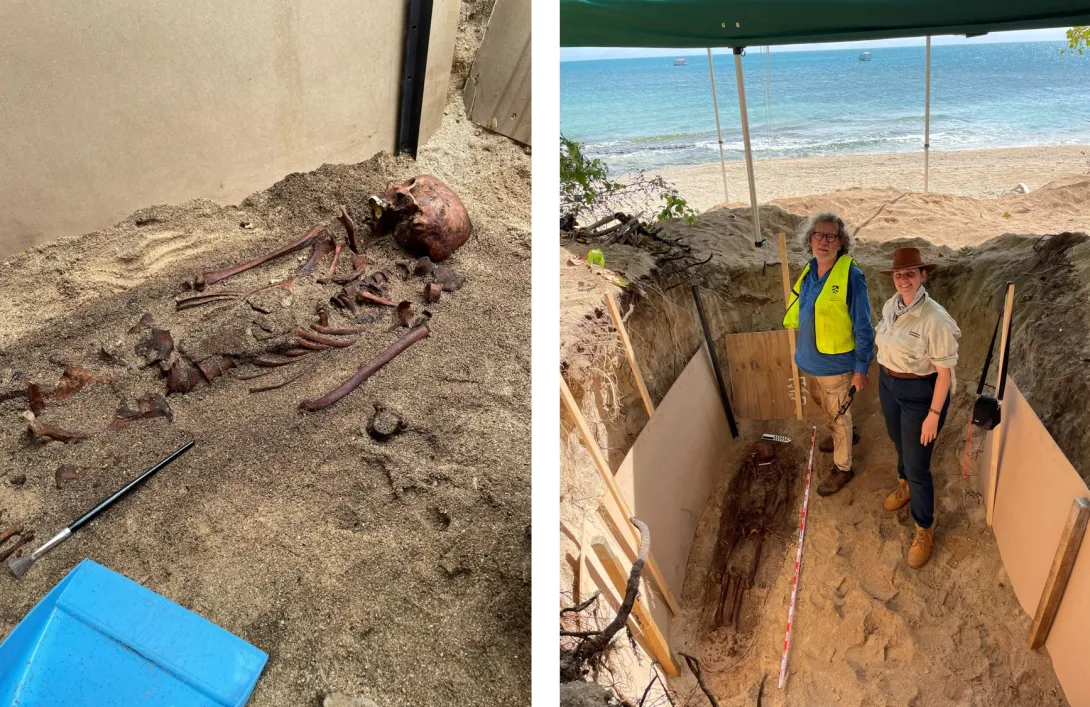
From here every detail was recorded: the simple burial without jewellery or coffin fittings, but with traces of dark fibres suggesting she had been wrapped in a blanket. On her chest lay a small, corroded metal plate, too fragile to reveal any markings, but deliberately placed.
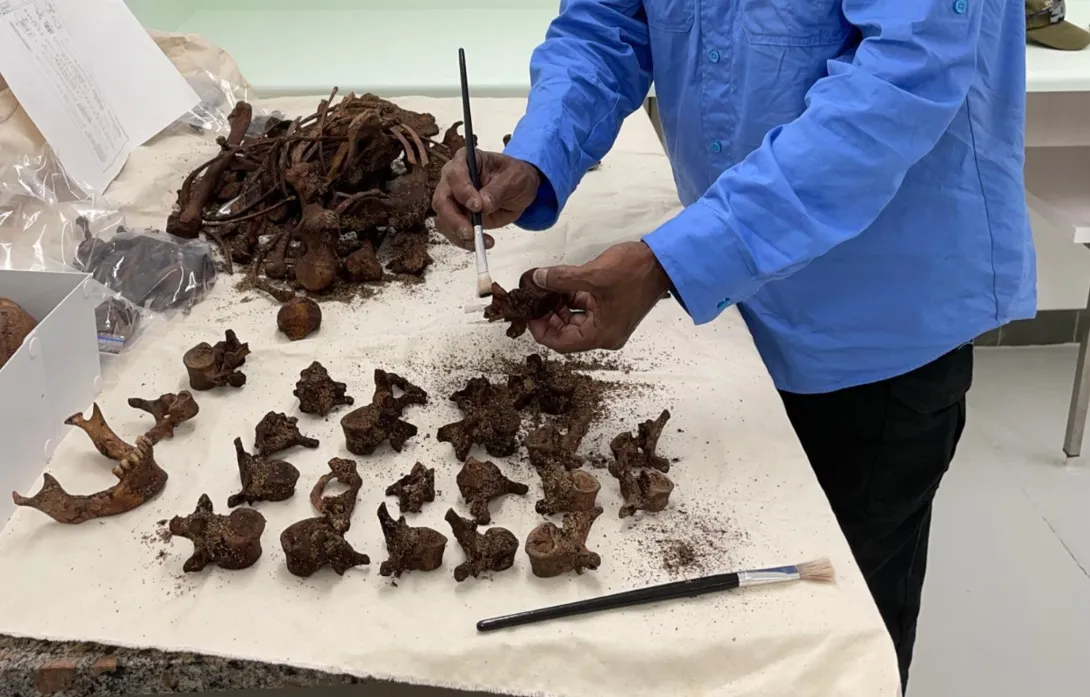
Further analysis showed a woman who lived with hardship. Her spine revealed scoliosis, she suffered from arthritis in her neck, a congenital abnormality in her knee, and her jaw indicated poor dental health. These conditions would have caused pain, possibly chronic, in her daily life. Yet she had travelled across the world, raising a child in isolation and supporting her husband in maintaining one of the north’s most important maritime safety stations.
“Jane’s story is extraordinary because it connects so many threads: migration, maritime history and navigation, the challenges of women on the frontier,” DETSI Principal Heritage Officer Celeste Jordan said. “Through her, we glimpse what life was like for women and families who kept the lights burning, ensuring mariners, supplies and people could safely traverse the Great Barrier Reef.”
Who was Jane Anne Owen?
Jane Anne Owen, née Coulson, was born in Hexham, Northumberland, England, on 25 November 1836. In 1873, when she was 36 years old, Jane boarded the immigrant ship Great Queensland as a “second cabin” passenger, travelling with her brother William and sister-in-law Sophia Frances. On the same ship, but in the saloon class, was a Welsh-born mariner named Daniel Hugh Owen. When the ship arrived in Brisbane in September that year, Jane and Daniel were married three days later. The location of their berths on board the ship suggest they might even have met on their 3 month journey to Australia.
A year later their daughter, Susie Janet, was born in Surry Hills, Sydney. In 1878, Daniel was appointed the first superintendent of the newly constructed Low Islets Lightstation, a lonely outpost in Far North Queensland. Jane, Daniel and four-year-old Susie moved to the island, beginning a life of isolation and responsibility.
Supplies arrived by boat only every few weeks, cyclones were a seasonal threat, and medical help was far away. A Port Douglas newspaper in 1878 described how two large fires were seen burning on Low Island, a widely recognised distress signal. When a customs boat finally reached the island two hours later, it found Jane and Daniel desperate for help as their daughter suffered a severe fit of whooping cough.
Only two years later, in July 1880, Jane herself fell gravely ill. After nine days of sickness, she died at just 41 years old. Her death certificate listed ‘congestion of the lungs’. Similarly, a Port Douglas newspaper noted she suffered from consumption (tuberculosis). The news spread quickly along the coast, noting she had “endeared herself to many near and far.” She was buried the next day on the island she had come to call home.
Her husband continued at the lightstation, raising young Susie in the wake of their loss. Jane’s grave became a marker not only of her life, but of the hardships faced by lighthouse families who kept the country’s seas safe.
Reburial and remembrance
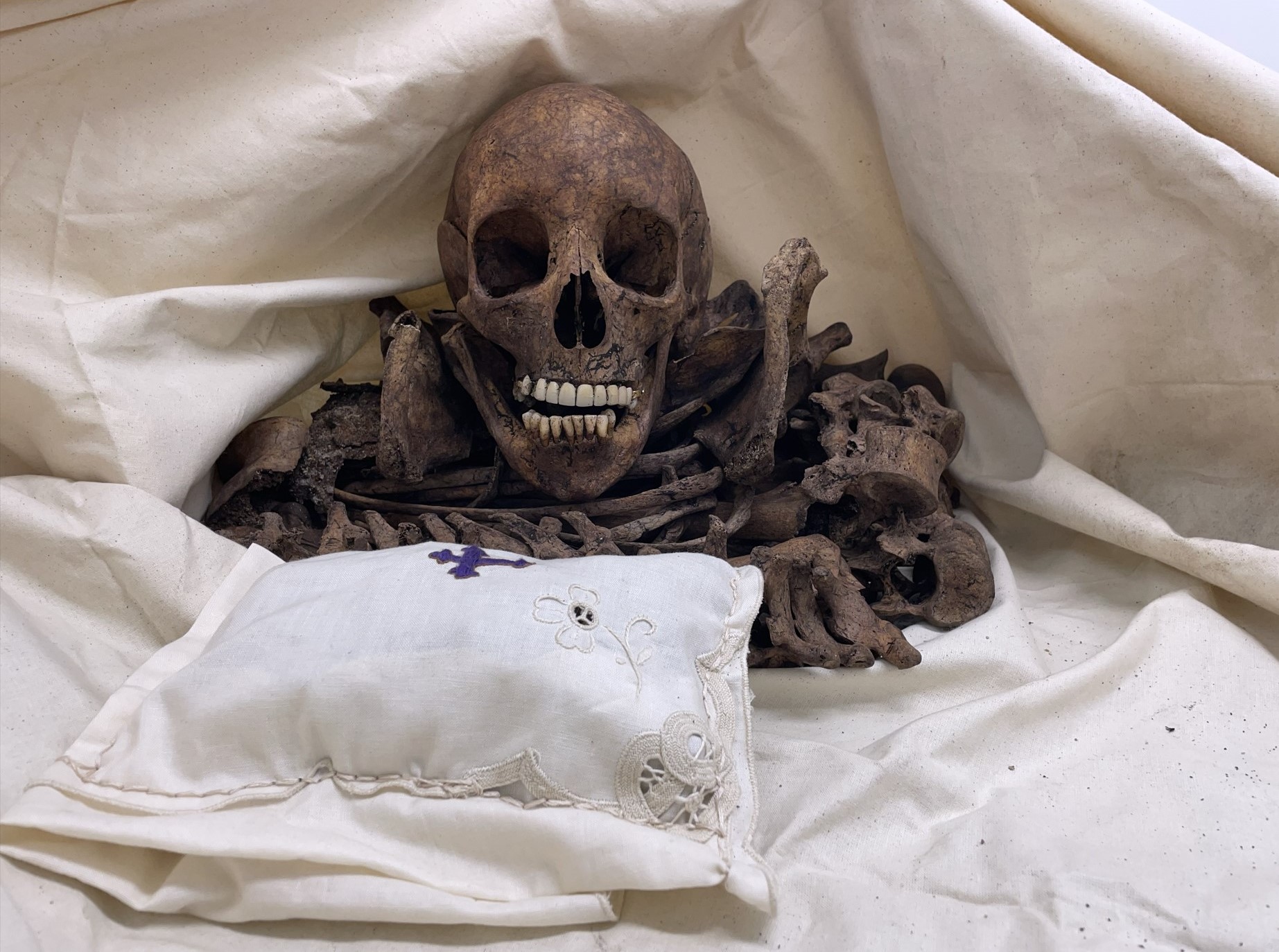
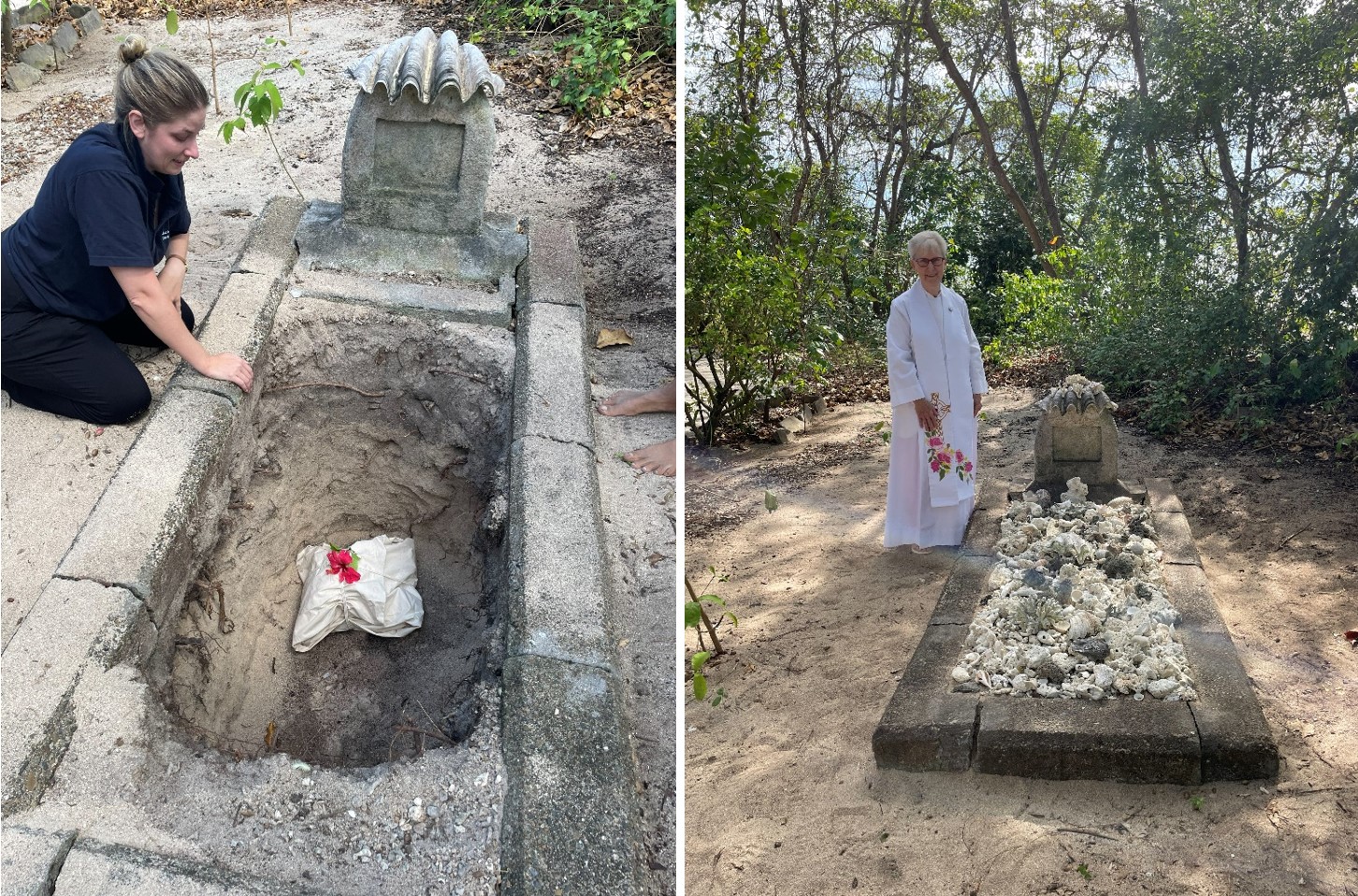
Jane’s remains were delicately cleaned, recorded and placed in a hand-sewn calico shroud for reburial. Smaller bones, fragments and the corroded metal objects were sewn into a cotton handkerchief marked with a hand-stitched cross, modelled on the Hexham Abbey Cross from Jane’s hometown in Northumberland. The purple and brown thread symbolised both mourning and continuity.
The new grave, inland from the eroded shoreline, was prepared to face east as her original burial had. All sediment sifted from her bones was placed back beneath her, ensuring nothing was lost.
In respecting Jane’s faith, listed on her birth certificate as Church of England (now the Anglican Church), the local Anglican minister was invited to recommitted Jane’s remains to the earth in the presence of the project team. Wearing a stole embroidered with English roses to honour Jane’s ancestral home, the minister conducted the heartfelt ceremony on 12 September 2024. All involved stood together as words of prayer were shared, returning Jane to rest.
Jane’s legacy
Heritage is not always about grand monuments. Sometimes it is about a single grave, weathered and almost forgotten, that tells a story of human endurance on the edge of civilisation.
For marine park managers, Jane’s story highlights that managing the Great Barrier Reef means protecting more than corals or fish. It also means safeguarding the historic heritage values of places like Low Island: the lightstations that guided ships, and the stories of lighthouse families.
Jane’s daughter Susie grew up in Queensland but never married or had children. She died in 1950, aged 75. Captain Daniel Owen continued as superintendent at Low Isles until 1899, later remarrying Agnes Bellairs, daughter of the late lightkeeper from Dent Island and they had one daughter together. He died in Brisbane in 1907 and is buried at Toowong.
Jane, meanwhile, remains part of the island’s historic fabric. Her relocated grave stands inland, stable and safe from erosion, where visitors can pause and reflect on her life. Interpretive signage is being developed to share her story.
In the end, the project wasn’t only about saving a headstone from the sea. It was about recognising that the Reef holds human stories as fragile and precious as coral. The Reef’s beauty is not only in its colours and creatures, but in the lives, like Jane’s, that are forever woven into its story.
For images and media enquiries, please contact the media teams below:
Great Barrier Reef Marine Park Authority | (07) 4750 0846 | media@gbrmpa.gov.au
Department of the Environment, Tourism, Science and Innovation | (07) 3339 5831 | media@des.qld.gov.au