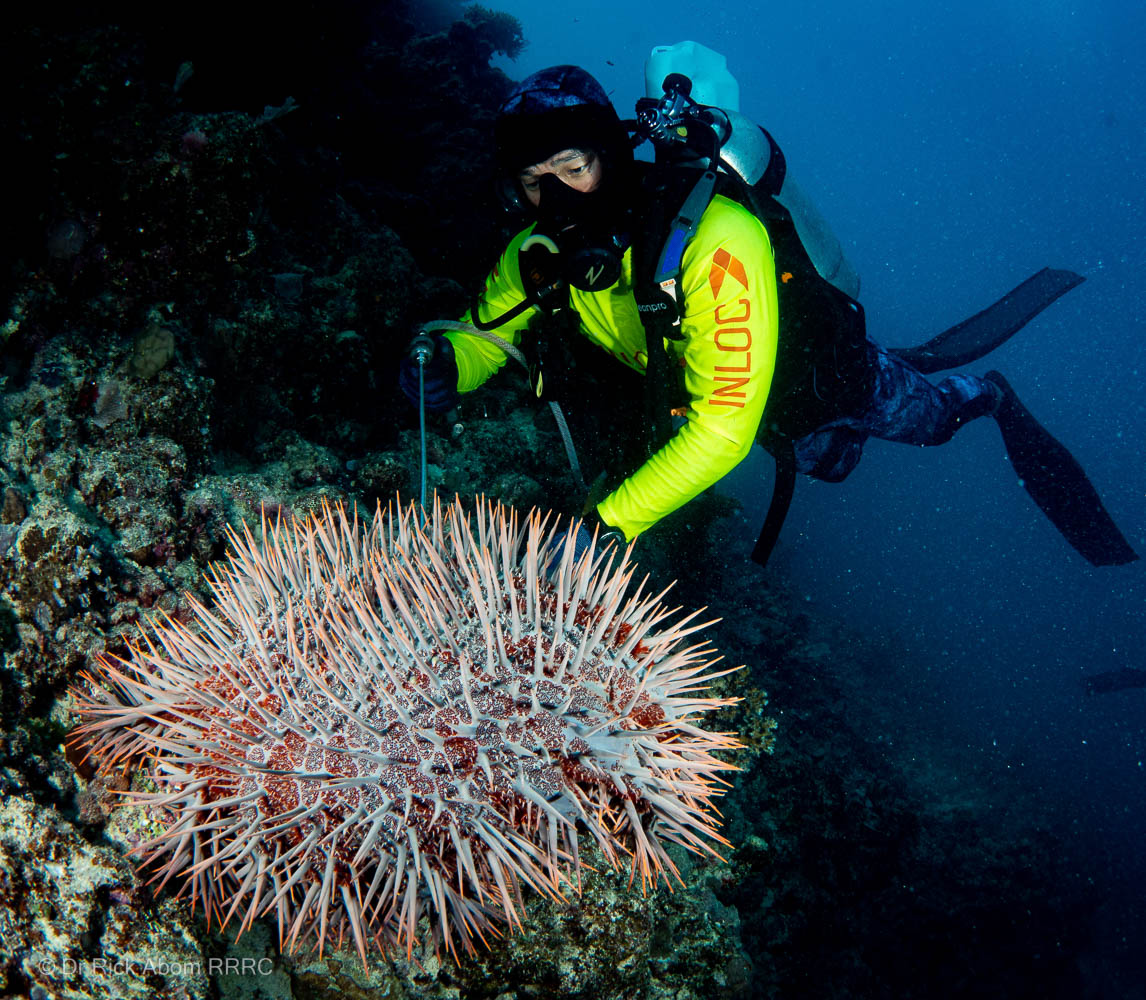
Crown-of-thorns Starfish (COTS) control is a foundational management action under the Australian Government’s Reef 2050 Long-Term Sustainability Plan (Reef 2050 Plan).
The primary objective of the COTS Control Program is to protect coral across a network of reefs by reducing COTS numbers to sustainable levels at which coral growth and recovery can outpace starfish predation. The Program deploys a fleet of vessels crewed with teams of specialist divers to conduct targeted outbreak surveillance and systematic culling operations across 150 - 250 reefs each year. Targeted COTS control is a proven effective, adaptive, and scalable action that protects coral across entire reefs and regions of the Great Barrier Reef Marine Park.
This interactive dashboard provides an overview of COTS Control Program operational delivery and outcomes. It presents near real-time reef-level estimates of COTS outbreak status, COTS culling catch-per-unit effort (CPUE) and coral cover.
Previous annual report dashboards can be accessed via the links at the bottom of the page. COTS Control Program data is available by request via cotsprogram@gbrmpa.gov.au.
This dashboard is best viewed on a desktop. Tap here for a mobile friendly version.
Definitions
Outbreak status is assigned to all actioned reefs. It is calculated as the average number of COTS recorded across all manta tow surveys conducted at each reef and is expressed as COTS/tow (2,000 m2 survey area).
- No COTS Detected – Manta tow surveys recorded no COTS or COTS feeding scars.
- No Outbreak – Manta tow surveys recorded 0 - <0.11 COTS/tow.
- Potential Outbreak – Manta tow surveys recorded 0.11 - <0.22 COTS/tow.
- Established Outbreak – Manta tow surveys recorded 0.22 - <1 COTS/tow.
- Severe Outbreak – Manta tow surveys recorded >=1 COTS/tow.
COTS often aggregate for both feeding and spawning and this can result in large variability in starfish density among replicate manta tow surveys at each reef.
Although average COTS numbers are low on ‘No Outbreak’ reefs, there may be specific sites on these reefs where starfish numbers are above sustainable levels and targeted culling is required to protect coral.
- ‘Catch per unit effort (CPUE)’ is the total number of COTS culled divided by the number of diver minutes spent searching for and culling starfish. CPUE is categorised as follows:
- 0.00 - <0.02 COTS/min: COTS density is below the level at which coral growth can outpace coral loss from starfish predation. COTS spawning success may be suppressed.
- 0.02 - <0.04 COTS/min: COTS density is low enough to sustain coral growth on reefs with < 40% live coral cover.
- 0.04 - <0.08 COTS/min: COTS density is low enough to sustain coral growth on reefs with > 40% live coral cover.
- 0.08 - <0.2 COTS/min: COTS density is too high and coral loss from starfish predation will outpace coral growth.
- >=0.2 COTS/min: COTS density is well above sustainable densities and rapid coral loss from starfish predation will occur (coral loss to below 5% live cover is expected within 12 months).
- 'Percentage categories of live coral cover’ are average hard coral cover estimates generated from manta tow surveys at each actioned reef. Tracking changes in coral cover status through time provides an indication of the coral protection outcomes achieved by the COTS Control Program and helps to quantify other cumulative impacts on reef health.
- Estimates from Reef Health Impact Surveys (RHIS) are also provided in the summary statistics panel. COTS Control Program RHIS are predominantly conducted in shallow reef slope and crest habitats. They typically generate higher estimates of coral cover than manta tow surveys.
Previous reports
- During 2025-26, the Crown-of-thorns Starfish Control Program:
- Actioned 220 reefs for surveillance and COTS culling where required
- Conducted 18,417 manta tow surveys and 3,181 Reef Health and Impact Surveys (RHIS)
- Culled 64,879 COTS across 13,210 hectares of reef habitat
- Spent 17,528 hours underwater culling
- During 2024-25, the Crown-of-thorns Starfish Control Program:
- Actioned 232 reefs for surveillance and COTS culling where required
- Conducted 18,282 manta tow surveys and 3,457 Reef Health and Impact Surveys (RHIS)
- Culled 73,881 COTS across 11,710 hectares of reef habitat
- Spent 18,008 hours underwater culling
This dashboard is best viewed on a desktop. Tap here for a mobile-friendly version.
- About the 2024-25 Report Dashboard:
- This 2024-25 report includes reefs actioned for surveillance and culling by the COTS Control Program and the Reef Joint Field Management Program (RJFMP). The COTS Control Program integrates Great Barrier Reef monitoring data and intelligence from the Australian Institute of Marine Science (AIMS) Long-Term Monitoring Program (LTMP) to inform strategic planning and operational decisions. AIMS LTMP reports and data can be accessed via the Reef Reports Hub.
- Summary data presented in this report extends from 2012 to June 30th 2025.